

Weightlifting isn’t just for building muscle – it can improve endurance too. By focusing on heavy strength or explosive movements, endurance athletes like runners and cyclists can boost efficiency, power, and injury resistance. Studies show adding strength training to cardio can increase power output by 7% and improve endurance metrics like VO2max. For best results:
- Energy Efficiency: Heavy lifting trains muscles to use less oxygen, making movement more efficient.
- Strength Gains: Boosts force production without adding bulk, improving endurance performance.
- Injury Prevention: Strengthens tendons, ligaments, and stabilizing muscles to reduce injury risk.
- Endurance Benefits: Combining weightlifting with cardio outperforms cardio alone for metrics like sprint finishes.
While cardio is better for calorie burn and aerobic capacity, weightlifting improves movement efficiency and builds resilience. A balanced plan – two strength sessions weekly alongside cardio – can maximize endurance and overall fitness.
1. Weightlifting for Endurance
Energy Efficiency
Weightlifting can make your body more efficient at using oxygen during endurance activities. This concept, known as "economy", refers to how much oxygen your body consumes at a given intensity. Athletes with better economy use less oxygen and energy to perform the same task compared to those with poorer economy – think of it like a car that gets better mileage with less fuel.
Heavy strength training plays a key role here. It enhances the recruitment of fast-twitch muscle fibers to support slow-twitch fibers when fatigue sets in. This reduces the energy demand for each movement, whether you’re running or cycling. The result? You can maintain your pace with less strain on your body.
But the benefits of weightlifting don’t stop at energy efficiency – it also significantly boosts strength.
Strength Gains
Incorporating heavy-resistance training into your routine can lead to major strength improvements that directly enhance endurance performance. For example, a study published in the Journal of Applied Physiology followed eight trained cyclists and runners over 10 weeks. By adding heavy-resistance workouts three times a week while keeping their endurance training constant, participants saw a 30% increase in leg strength. This translated to an 11% improvement in short-term cycling endurance, a 13% boost in running endurance, and a jump in long-term cycling time to exhaustion from 71 to 85 minutes.
These improvements stem from an increase in the Rate of Force Development (RFD), allowing athletes to generate the necessary force more quickly during each movement. This adaptation enhances performance without adding unwanted muscle mass .
Injury Prevention
Beyond performance, strength training also helps protect against common endurance-related injuries. Repetitive activities like running or cycling place constant stress on bones, tendons, and ligaments. Resistance training strengthens these structures and activates stabilizing muscles often overlooked in linear cardio routines. This creates a more durable body that can handle higher training volumes without breaking down, giving endurance athletes a vital edge.
Endurance Performance
Combining weightlifting with cardio – referred to as concurrent training – outshines cardio alone when it comes to improving key endurance metrics like time trial performance and sprint finishes. For instance, cyclists who included heavy strength training in their programs recorded a 7% higher power output during final five-minute maximal sprints compared to those who focused solely on endurance training.
| Training Type | Load (% 1RM) | Rep Range | Primary Benefit |
|---|---|---|---|
| Heavy Strength | 80–90%+ | 2–5 | Improved economy and maximal force |
| Explosive | 0–60% | 1–6 (fast) | Tendon stiffness and power endurance |
| Muscular Endurance | 40–60% | 15–25+ | Mitochondrial volume and fatigue resistance |
A 2011 study published in the Scandinavian Journal of Medicine & Science in Sports followed competitive cross-country skiers over 12 weeks. Participants added upper and lower body heavy strength training (three sets of 5–10 RM) to their usual ski training. The results? Significant improvements in VO2max during roller skiing and double poling performance – with no increase in muscle mass. This shows that heavy lifting can enhance aerobic capacity, even in elite endurance athletes.
Weightlifting offers a unique advantage by improving endurance performance in ways traditional cardio training alone can’t achieve.
sbb-itb-9317277
2. Standard Cardio for Endurance
Energy Efficiency
When it comes to burning calories, standard cardio outpaces weightlifting by a significant margin – about 50–100% more calories per minute. For example, a 175-pound individual running a 10-minute mile burns roughly 817 calories per hour, compared to 474 calories during intense weightlifting.
The key difference lies in what limits performance. Cardio is constrained by oxygen delivery (VO2max), while weightlifting is limited by muscular force production. As Zachary Keith, BSc CSCS CISSN, explains, > "Whatever limits further movement is what gets trained in any exercise".
Cardio also plays a major role in improving glucose efficiency within muscles. Think of it this way: weightlifting increases your "storage tank" by building muscle mass, but cardio enhances your "mileage" by making muscles better at absorbing glucose with less insulin. Over a year, combining cardio with weightlifting improved insulin sensitivity by 71%, compared to 44% for diet alone.
In addition to burning calories and improving glucose processing, cardio training directly targets the core factors that drive endurance.
Endurance Performance
Standard cardio is particularly effective at improving endurance performance by focusing on key factors like VO2max and lactate threshold. In one study, HIIT cycling boosted predicted VO2max by 5.3 mL⋅kg⁻¹⋅min⁻¹, nearly doubling the improvement seen with HIIT-style weightlifting, which increased it by 2.8 mL⋅kg⁻¹⋅min⁻¹.
Cardio also drives unique cellular changes that weightlifting doesn’t. It increases both mitochondrial and capillary density, which are critical for sustained aerobic activity. For instance, a study found that moderate cycling improved capillary density by 32%, while HIIT sprints increased it by 27% over six weeks. In contrast, weightlifting showed no notable improvement in this area. As Hirofumi Tanaka from the University of Colorado puts it, > "Endurance training facilitates aerobic processes, whereas resistance training increases muscular strength and anaerobic power".
To achieve these cardiovascular benefits, the body needs sustained effort – about 10 to 15 minutes at 85–100% of maximum heart rate. Weightlifting, even when intense, typically involves sets that are too short to provide this type of stimulus.
Complete Guide to Strength Training for Endurance Athletes
Pros and Cons
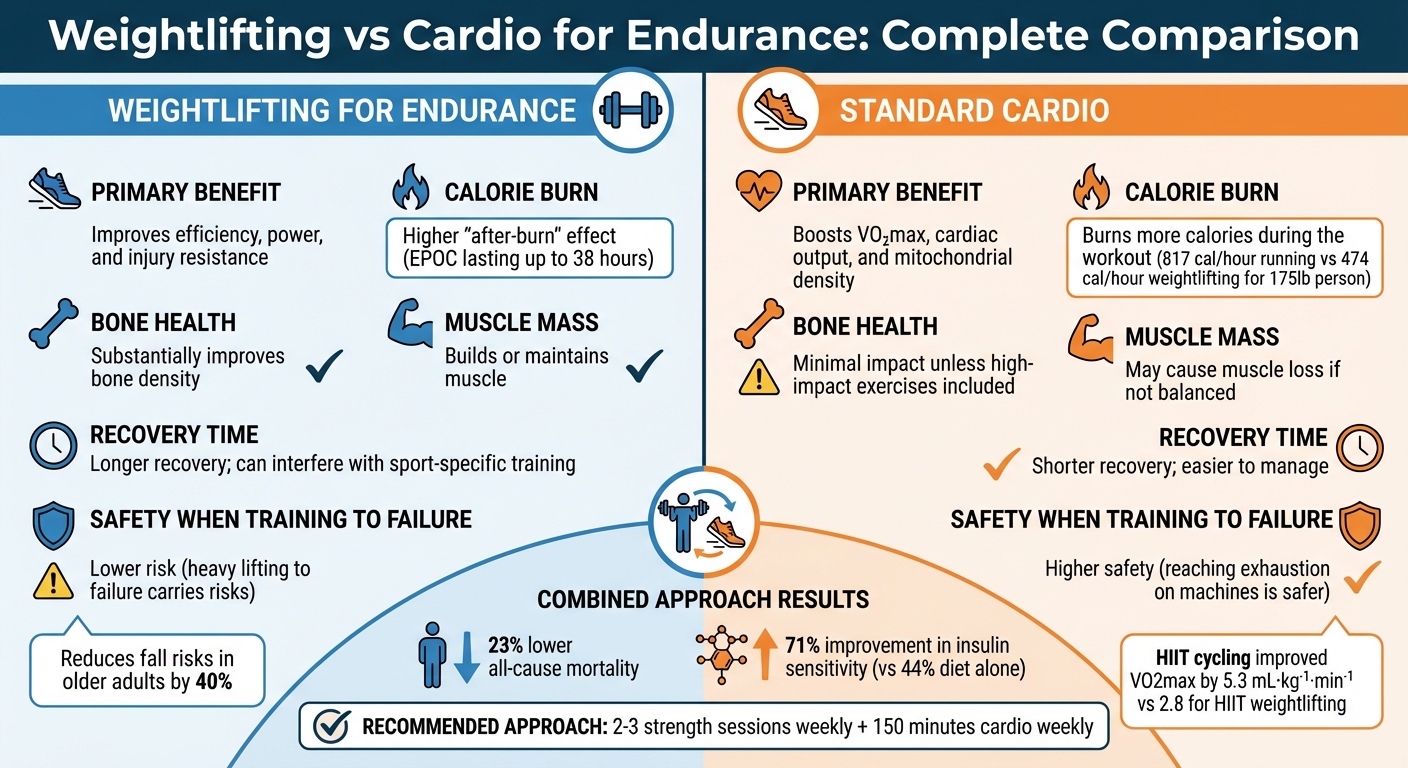
Weightlifting vs Cardio for Endurance: Benefits Comparison
Weightlifting and standard cardio each bring their own endurance benefits, but they come with trade-offs. Understanding these differences can help you make smarter fitness choices.
Weightlifting enhances movement efficiency, power output, and bone strength, reducing fall risks in older adults by 40%. Mike Ricci, a USAT Level 3 Elite Coach, explains:
"Lifting heavy weights acts as an insurance policy for your body by strengthening tendons, ligaments, collagen, and bone density".
Although weightlifting offers only modest improvements in VO₂max compared to HIIT cycling, it excels in building economy and power. However, pushing heavy lifts to the point of metabolic fatigue can increase the risk of injury.
Standard cardio, on the other hand, is unmatched for developing aerobic capacity. It boosts mitochondrial and capillary density – adaptations that weightlifting doesn’t provide. Cardio is also safer to perform to exhaustion, making it easier to push your limits without significant injury risks. That said, cardio can lead to muscle loss and provides limited bone-strengthening benefits unless high-impact exercises are included.
Here’s a quick comparison of the two:
| Feature | Weightlifting for Endurance | Standard Cardio |
|---|---|---|
| Primary Benefit | Improves efficiency, power, and injury resistance | Boosts VO₂max, cardiac output, and mitochondrial density |
| Calorie Burn | Higher "after-burn" effect (EPOC lasting up to 38 hours) | Burns more calories during the workout |
| Bone Health | Substantially improves bone density | Minimal impact unless high-impact exercises are included |
| Muscle Mass | Builds or maintains muscle | May cause muscle loss if not balanced |
| Recovery Time | Longer recovery; can interfere with sport-specific training | Shorter recovery; easier to manage |
| Safety When Training to Failure | Lower; heavy lifting to failure carries risks | Higher; reaching exhaustion on machines is safer |
Blending weightlifting and cardio can address multiple endurance needs, as discussed earlier. A smart strategy might include focusing on heavy lifting during the off-season to build strength and resilience, then maintaining one high-quality strength session per week during competition periods. This helps preserve strength gains without compromising sport-specific training. A balanced approach like this ensures you maximize the benefits of both methods.
Conclusion
Tailor your workout plan to your goals: focus on cardio to enhance aerobic capacity, and include two to three strength sessions weekly to protect your joints, improve technique, and lower your risk of injuries.
Beyond boosting performance, combining cardio and strength training offers broader health benefits. Research shows that adults who meet the guidelines of 150 minutes of cardio weekly and at least two strength sessions experience the lowest mortality risk. In fact, incorporating strength training into your cardio routine can lower all-cause mortality by 23%. As Peloton instructor Ben Alldis explains:
"A healthy combination of strength and cardio training will allow your body to perform at its best, letting the two systems complement each other rather than compete".
If endurance is your priority, focus on heavy, low-rep strength training (2–5 reps). This approach improves movement efficiency and power while minimizing fatigue. During competition season, stick to one quality session per week, and increase to two during the off-season.
FAQs
How can weightlifting enhance endurance for runners and cyclists?
Weightlifting can play a key role in boosting endurance for runners and cyclists by building strength, improving efficiency, and reducing the risk of injuries. When your muscles are stronger, your body becomes more energy-efficient – using less effort to maintain the same pace. This improved motion economy can translate to faster and more effective performance. Plus, stronger muscles, connective tissues, and bones offer better support, helping you train harder and more consistently without breaking down.
It doesn’t stop there. Weightlifting also targets critical endurance factors like fatigue resistance and lactate threshold – two elements that are essential for excelling in long-duration activities. By focusing on gaining strength rather than bulking up, athletes can maintain an ideal strength-to-weight ratio, which is crucial for endurance sports like running and cycling. Adding weightlifting to your training routine could mean fewer injuries and more time performing at your best.
How does weightlifting compare to cardio for building endurance?
Weightlifting and cardio each play a role in building endurance, but they achieve it through different mechanisms. Weightlifting, particularly with higher repetitions and moderate to heavy loads, boosts muscular strength and improves neuromuscular efficiency. It also helps enhance muscle endurance by increasing type IIA muscle fibers, which are crucial for maintaining activity over time. Beyond that, weightlifting can improve movement efficiency, lower the risk of injuries, and contribute to a healthier body composition.
Cardio, meanwhile, targets the cardiovascular and respiratory systems. It enhances VO2 max, strengthens the heart, and improves oxygen delivery throughout the body – all essential for sustaining long-duration efforts. While cardio directly builds stamina and aerobic capacity, weightlifting complements it by fortifying muscles and supporting overall physical performance. Combining these two forms of training offers a well-rounded approach to improving endurance.
How does weightlifting help endurance athletes avoid injuries?
Weightlifting plays a key role in helping endurance athletes avoid injuries by fortifying muscles, bones, and connective tissues. This added strength boosts overall stability and helps the body handle the physical demands of training and competition. Stronger muscles and joints also lower the chances of overuse injuries while improving motion efficiency, allowing athletes to perform with less strain.
Resistance training also contributes to better body composition and enhances muscular endurance. These benefits help the body absorb impacts more effectively, reducing the stress placed on joints during extended activities. By adding weightlifting to their training regimen, endurance athletes can build a stronger, more balanced physique, reducing injury risks and supporting better performance over time.