
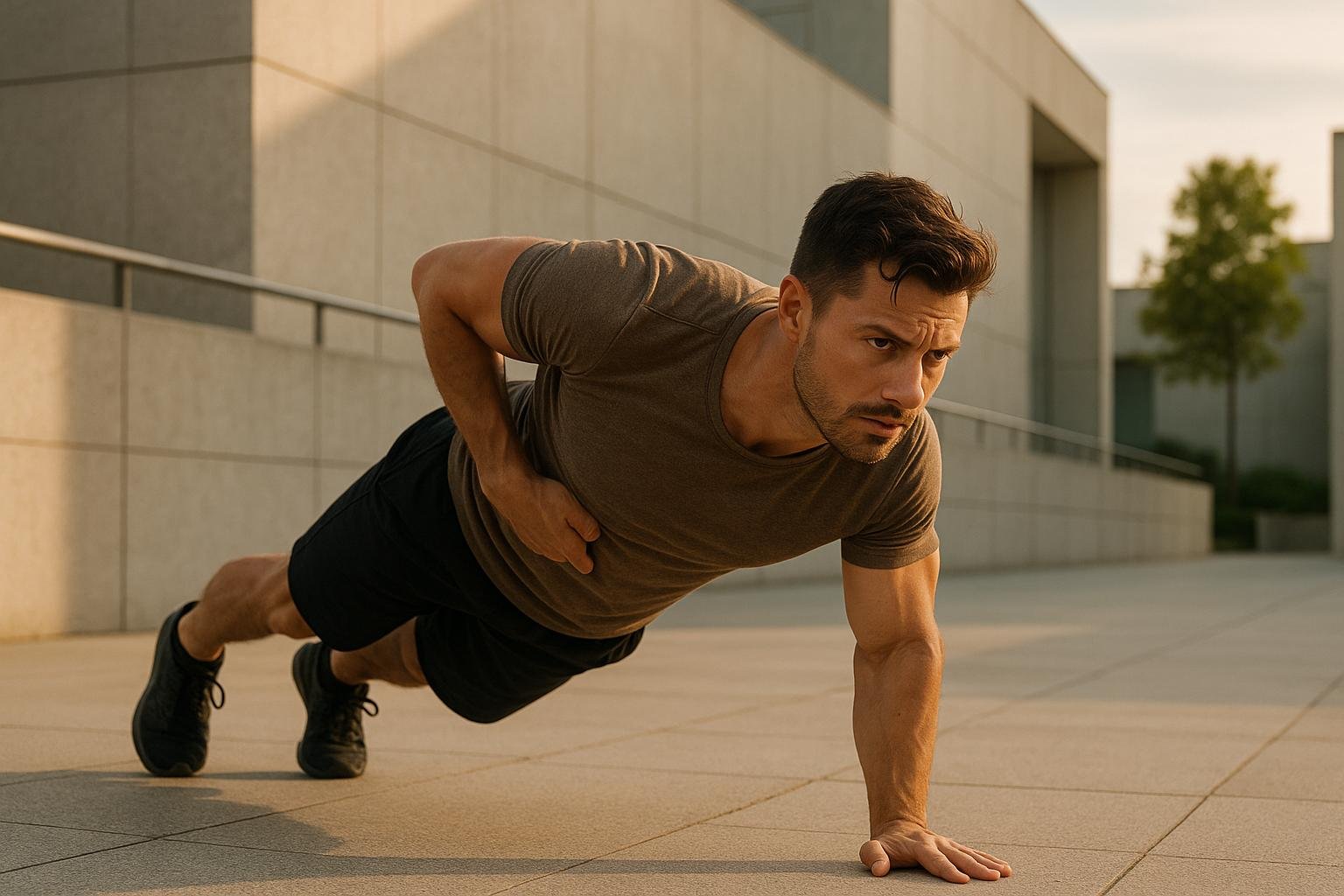
Progressive overload is the key to improving strength and muscle growth. In calisthenics, this means gradually increasing the difficulty of exercises. Start with beginner-friendly moves like wall push-ups and assisted pull-ups, then advance to challenging exercises like one-arm push-ups and dragon flags. These progressions require little to no equipment, making them ideal for home workouts.
Key Takeaways:
- Beginner Exercises: Wall push-ups, assisted pull-ups.
- Intermediate Progressions: Standard push-ups, archer push-ups, wide-grip pull-ups.
- Advanced Moves: One-arm push-ups, pistol squats, dragon flags.
- Progressive Overload: Increase reps, adjust angles, or add resistance to keep progressing.
- Minimal Equipment: Most exercises only need a wall, pull-up bar, or sturdy surface.
Quick Comparison
| Exercise | Difficulty | Primary Muscles | Equipment |
|---|---|---|---|
| Wall Push-Ups | Beginner | Chest, shoulders, triceps | None |
| Standard Push-Ups | Beginner | Chest, core | None |
| Archer Push-Ups | Intermediate | Chest, triceps, core | None |
| One-Arm Push-Ups | Advanced | Chest, triceps, core | None |
| Assisted Pull-Ups | Beginner | Back, biceps | Pull-up bar, bands |
| Wide-Grip Pull-Ups | Intermediate | Lats, upper back | Pull-up bar |
| Pistol Squats | Advanced | Quads, glutes | None or assistance |
| Dragon Flags | Advanced | Core, hip flexors | Bench or anchor |
Start at your level and progress steadily. Focus on form and gradually increase intensity for long-term results.
Do THIS To Apply Progressive Overload With Calisthenics (3 Methods)
1. Wall Push-Ups
Wall push-ups are a great starting point for anyone venturing into push-up progressions. They reduce the strain compared to traditional push-ups, making them perfect for building strength gradually while focusing on proper technique. Think of them as the stepping stone to more advanced calisthenics.
Exercise Difficulty (Progression Level)
As a beginner-friendly exercise, wall push-ups are the easiest entry into the push-up family. They don’t demand much upper body strength, thanks to the upright position, which naturally decreases the load on your muscles. This makes them ideal for those just starting out or looking to ease into a fitness routine.
Muscle Groups Targeted
Wall push-ups primarily target the chest (pectoralis major), shoulders (deltoids), and triceps. They also engage your core to maintain stability, which is crucial for proper form. The upright position helps beginners focus on activating the right muscles, building a solid foundation for future progressions.
Required Equipment
All you need is a sturdy wall – no weights, machines, or fancy gear required. This makes wall push-ups accessible no matter where you are, whether it’s your living room, office, or any indoor space.
Overload Potential
To build strength over time, you can gradually increase the challenge. Start with 3 sets daily, adding more reps as your strength improves. You can also:
- Increase the number of sets or reps.
- Shorten rest periods between sets.
- Adjust your body angle by stepping farther from the wall, which increases the load on your muscles.
- Slow down your tempo for more controlled movements.
Once you can perform 15–20 wall push-ups with proper form, it’s time to either adjust your angle further or move on to a more advanced variation. These small adjustments not only boost strength but also prepare you for tougher challenges ahead.
2. Standard Push-Ups
Once you’ve built a foundation with wall push-ups, it’s time to step up the intensity with standard push-ups. These not only challenge your upper body strength but also engage more muscle groups by distributing your full body weight across your arms, chest, and core. It’s a solid next step for advancing your fitness journey.
Exercise Difficulty (Progression Level)
Standard push-ups are a beginner-to-intermediate exercise that requires moderate strength in your upper body and core. They’re a natural progression after mastering wall or knee push-ups and act as a stepping stone to advanced moves like archer or one-arm push-ups.
Unlike assisted variations, standard push-ups demand that you fully support your body weight in a horizontal position. This increases the challenge, as your core and lower back muscles work harder to stabilize your body – something less emphasized in wall push-ups.
Muscle Groups Targeted
This exercise is a powerhouse for engaging multiple muscle groups at once. The primary muscles worked include the chest (pectoralis major), the back of the upper arms (triceps brachii), and the front shoulders (anterior deltoids). Meanwhile, your core muscles – like the rectus abdominis and obliques – along with the serratus anterior, lower back, and even glutes, play a supporting role.
By combining upper body strength with core stability, standard push-ups also help improve functional movements you use in everyday life.
Required Equipment
You don’t need any fancy equipment for standard push-ups – just a flat and stable surface. If you want to add a bit more challenge or comfort, you can use optional tools like push-up bars or hexagonal dumbbells. These can elevate your hands, allowing for a deeper range of motion. Still, these extras are entirely optional for the basic version.
Overload Potential
Standard push-ups are incredibly versatile when it comes to progressive overload, which is key for building muscle and strength. Research published in the Journal of Strength and Conditioning Research in 2016 found that bodyweight exercises like push-ups can produce muscle growth comparable to traditional weightlifting.
To increase the challenge, you can elevate your feet for more resistance, wear a weighted vest or backpack, or use push-up bars for a greater range of motion. These adjustments ensure you continue to push your limits and make steady strength gains.
Beginners should aim for 3 sets of 5–10 reps, focusing on perfect form. As you get stronger, work up to 3–5 sets of 10–20 reps. For muscle growth, the ideal range is typically 6–20 reps per set, but some studies suggest benefits even up to 40 reps per set. Once you can easily complete multiple sets of 15–20 push-ups with proper form, you’re ready to explore more advanced variations or add extra resistance. This solid foundation will prepare you for challenges like archer push-ups.
3. Archer Push-Ups
Archer push-ups are a challenging variation that shifts most of your weight onto one arm while extending the other out to the side. They serve as a stepping stone toward mastering one-arm push-ups, helping to build impressive upper body strength and control.
Exercise Difficulty (Progression Level)
Archer push-ups fall into the intermediate to advanced category of calisthenics progressions. They come into play once you’ve nailed standard push-ups and are looking to push yourself further before tackling full one-arm push-ups. The exercise demands that one arm take on most of the workload, while the other provides balance. This setup not only increases muscle activation but also tests your balance and control.
Muscle Groups Targeted
This movement works your chest (pectoralis major), shoulders (deltoids), and triceps, with the primary arm taking on the heavier load. Meanwhile, your core and back muscles stabilize your body to counteract the uneven distribution of weight. The unilateral nature of the exercise is also great for spotting and addressing strength imbalances between your left and right sides.
Required Equipment
You don’t need any special equipment for archer push-ups. A flat, stable surface is all it takes to get started. For those looking to tweak the exercise, push-up handles or parallettes can be used to increase the range of motion or reduce wrist strain, but these are entirely optional.
Overload Potential
Archer push-ups are a fantastic way to incorporate progressive overload into your routine. By shifting more weight onto the working arm and increasing the range of motion, they naturally ramp up the intensity. To take it up a notch, you can reduce the assistance from your non-working arm, add more reps, or experiment with slower tempos for an even greater challenge.
4. One-Arm Push-Ups
One-arm push-ups are a challenging progression that demands a blend of strength, balance, and control. By shifting nearly all your body weight onto one arm, this exercise becomes a true test of upper body power and serves as a milestone for anyone serious about calisthenics.
Exercise Difficulty (Progression Level)
This move is considered expert-level – far more demanding than standard or archer push-ups. While archer push-ups help you get used to unilateral loading, one-arm push-ups take it a step further by removing almost all assistance from the non-working arm. To prepare, aim to master at least 30 standard push-ups and 10–15 archer push-ups per side before tackling this advanced exercise. One-arm push-ups represent the culmination of the progressive overload journey, requiring intense focus and strength.
Muscle Groups Targeted
One-arm push-ups activate a wide range of muscles. The chest (pectoralis major), triceps, and anterior deltoids take on the bulk of the load, while the core – particularly the obliques and rectus abdominis – works hard to stabilize your body and prevent rotation. Additionally, stabilizing muscles in the shoulders, back, and hips play a crucial role, making this exercise not only a test of strength but also an effective way to identify and address imbalances between your left and right sides.
Required Equipment
The beauty of one-arm push-ups is that they require no equipment. All you need is your body and a flat surface, making them perfect for home workouts. If needed, minimal aids like parallettes or a yoga mat can provide extra grip or slight modifications as you progress.
Overload Potential
One-arm push-ups offer plenty of room for progression. You can increase reps and sets, slow down the lowering phase, reduce rest time, or elevate your feet to make the exercise more challenging. The scalability of this movement is one of its strongest features – small improvements in form, control, or repetition count can lead to noticeable strength gains. Studies show that bodyweight exercises like one-arm push-ups can promote muscle growth and strength on par with traditional weightlifting when overload principles are applied correctly. This makes them a powerful tool in any progressive calisthenics routine.
5. Assisted Pull-Ups
Assisted pull-ups are a great way for beginners to work on vertical pulling strength. By reducing the load, this exercise helps you build the strength needed for unassisted pull-ups while engaging a variety of upper-body and core muscles. It’s a smart starting point for understanding and tackling the challenges of pull-up progressions.
Exercise Difficulty (Progression Level)
Assisted pull-ups are considered a beginner-to-intermediate exercise, acting as the bridge between simpler movements like inverted rows and full, unassisted pull-ups. If you’re not yet able to complete an unassisted pull-up, this progression lets you practice the full range of motion while developing the strength you need. One of the best parts? You can tailor the level of assistance to match your current ability, gradually reducing it as you get stronger. Once you can manage 3 sets of 8-10 reps with minimal support, you’ll likely be ready to attempt unassisted pull-ups.
Muscle Groups Targeted
This exercise targets multiple key muscle groups. The latissimus dorsi, biceps brachii, rhomboids, and trapezius are the primary movers. Your forearms play a crucial role in maintaining grip strength, while your core muscles work to stabilize your body throughout the movement. Even with assistance, these muscles stay engaged, and as you reduce the support, their involvement increases. This makes assisted pull-ups a highly effective compound exercise for building upper-body pulling strength.
Required Equipment
You’ve got a few equipment options for assisted pull-ups, whether you’re working out at home or in the gym. Resistance bands are a favorite because they’re affordable, portable, and allow for adjustable levels of assistance. All you need is a sturdy pull-up bar and bands of varying thickness to modify the support as needed. If you’re at the gym, assisted pull-up machines provide a reliable, adjustable counterweight for consistent assistance. Partner assistance is another option, though it’s harder to standardize and may not always be as precise. For home workouts, make sure your pull-up bar is securely installed, and always check your resistance bands for wear and tear before starting your session.
Overload Potential
To keep progressing, focus on gradually reducing the assistance. For example, switch to thinner resistance bands or lower the counterweight on a machine. You can also increase the number of sets and reps, slow down your tempo to add time under tension, or refine your form for better muscle engagement. Research shows that progressive resistance training, including bodyweight exercises like assisted pull-ups, can lead to muscle growth comparable to traditional weightlifting when done correctly. Tracking your progress – such as the band thickness, sets, and reps – helps ensure you’re continuously challenging yourself and avoiding plateaus.
6. Wide-Grip Pull-Ups
Once you’ve got the hang of assisted pull-ups, it’s time to level up with wide-grip pull-ups. This variation focuses more on your upper back by positioning your hands wider than shoulder-width. The wider grip shifts the workload from your biceps to your lats and upper back, making it a great way to boost pulling strength.
Exercise Difficulty (Progression Level)
Wide-grip pull-ups are no walk in the park – they’re considered intermediate to advanced. The wider hand placement increases the challenge by putting more stress on your upper back and shoulders while dialing back biceps involvement. Most experienced individuals can manage 5–12 reps per set. If you’re a beginner, stick with assisted or standard pull-ups until you’ve built enough strength. Once you’re knocking out multiple sets of standard pull-ups with solid form, you’ll be ready to tackle the wide-grip version.
Muscle Groups Targeted
This variation hits the latissimus dorsi, teres major, rhomboids, trapezius, and rear deltoids more directly. While your biceps, brachialis, and forearms still assist, they’re less involved compared to standard pull-ups. Wide-grip pull-ups are a fantastic choice for building back width and sculpting that coveted V-taper physique.
Required Equipment
All you need is a sturdy pull-up bar that allows for a grip wider than shoulder-width. Make sure it’s securely mounted and can handle your weight safely.
Overload Potential
Wide-grip pull-ups are perfect for progressive overload, a key strategy for muscle growth and strength gains. Start by gradually increasing your reps and sets as you get stronger. Once you’re comfortable doing multiple sets of 8–12 reps with good form, you can up the ante by slowing down the lowering (eccentric) phase to increase time under tension. For even more intensity, add resistance using a weight vest or dip belt. Adjusting your grip width can also keep things challenging. To maximize results, focus on a full range of motion – pull your chin above the bar and lower until your arms are fully extended. This method not only boosts muscle activation but also sets you up for even tougher calisthenics challenges down the road.
sbb-itb-9317277
7. Pistol Squats
When it comes to building lower-body strength, few exercises are as challenging and rewarding as pistol squats. This advanced single-leg movement requires you to squat on one leg while keeping the other leg fully extended. It’s a true test of strength, balance, and mobility that separates beginners from seasoned practitioners. To perform a pistol squat, you’ll need a combination of ankle flexibility, hip mobility, and unilateral leg strength, making it one of the toughest bodyweight exercises to conquer. Mastering this move not only strengthens your lower body but also prepares you for even more demanding calisthenics exercises.
Exercise Difficulty (Progression Level)
Pistol squats are firmly in the advanced category of calisthenics. Most people can’t jump straight into a full pistol squat and need to work their way up through progressions like assisted pistol squats, box pistol squats, or negative variations.
Muscle Groups Targeted
This exercise primarily works your quadriceps, which power the squat. Your glutes and hamstrings help control the descent and push you back up, while calves, hip flexors, and core stabilizers keep you balanced. Since each leg works independently, pistol squats are also great for spotting and correcting strength imbalances between your legs.
Required Equipment
Pistol squats don’t require any equipment for the basic movement, making them a fantastic bodyweight exercise. However, when you’re learning, certain tools can make the process easier. For example:
- A box or bench can help you practice partial range of motion.
- Resistance bands provide assistance as you build strength.
- A light dumbbell or kettlebell can act as a counterweight to improve balance.
- A sturdy door frame or suspension trainer can offer support for assisted variations.
Once you’ve mastered the movement, all you need is your body and enough space to extend your leg fully.
Overload Potential
Pistol squats are excellent for long-term strength development because they allow for progressive overload. Research suggests that progressive overload with bodyweight exercises like pistol squats can promote muscle growth on par with traditional weightlifting. To keep challenging your muscles:
- Add more reps and sets as your strength increases.
- Slow down the eccentric (lowering) phase to increase time under tension.
- Squat deeper to extend your range of motion.
For an extra challenge, you can use a weighted vest or hold a dumbbell. As you get stronger, gradually reduce assistance by using lighter resistance bands or none at all. This way, you’ll continue to push your limits and build serious lower-body strength.
8. Nordic Hamstring Curls
Nordic hamstring curls are a powerful way to strengthen your hamstrings. To perform this exercise, kneel down with your feet securely anchored, and slowly lower your upper body toward the ground using controlled, deliberate movement. Research suggests that adding Nordic hamstring curls to your routine could lower the risk of hamstring injuries in athletes by as much as 51%.
Exercise Difficulty (Progression Level)
This is not a beginner-friendly exercise – it demands significant strength and control. If you’re just starting out, you might need some assistance, like resistance bands or help from a partner, to perform the movement correctly.
Muscle Groups Targeted
The main focus of Nordic hamstring curls is, of course, the hamstrings, engaging all three primary muscles in this group. But it doesn’t stop there. Your glutes and calves also play a stabilizing role, while your lower back and core work to maintain proper posture. This exercise is particularly valuable for building eccentric strength, which is your muscle’s ability to handle tension as it lengthens – a key factor in injury prevention and athletic performance.
Required Equipment
You don’t need fancy gear to do Nordic hamstring curls. At the very least, you’ll need a sturdy anchor for your feet, like a padded bar or even heavy furniture. To protect your knees, a padded mat or cushion is a good idea. If you’re new to this exercise, resistance bands can help lighten the load until you build enough strength. For those who want to invest, specialized Nordic curl benches are available but not essential.
Overload Potential
Nordic hamstring curls offer plenty of room for progression. As you get stronger, you can gradually reduce your reliance on assistance, increase your range of motion, or slow down the lowering phase to increase time under tension. You can also add more reps, sets, or even external resistance to keep challenging your muscles. A 2016 study in the Journal of Strength and Conditioning Research found that progressive resistance training – including exercises like Nordic curls – can lead to muscle growth comparable to traditional weightlifting. Keep pushing your limits, and this exercise can be a stepping stone to mastering more advanced calisthenics moves.
9. L-Sits
The L-Sit is a static hold that demands a mix of core strength, control, and balance. In this exercise, you support your body weight on your hands while keeping your legs extended in front of you, forming an "L" shape with your torso and legs. It’s a true test of strength and serves as a stepping stone to advanced calisthenics moves like handstands and planches.
Exercise Difficulty (Progression Level)
L-Sits fall into the intermediate-to-advanced range, so you’ll need a solid strength base before attempting the full movement. The exercise requires significant core and hip flexor strength. If you’re just starting, begin with tuck L-Sits, where your knees are bent and pulled toward your chest. Once you master that, progress to extending one leg at a time before attempting the full L-Sit.
The leap from a tuck to a full L-Sit is no small feat. Your core and hip flexors will need time to adjust to the added strain, so take it slow and steady.
Muscle Groups Targeted
L-Sits work your core and hip flexors like few other exercises, with the rectus abdominis doing most of the heavy lifting. Your quadriceps also play a big role, keeping your legs straight and parallel to the ground.
But it doesn’t stop there. Your triceps and shoulders work hard to stabilize your upper body, while your latissimus dorsi helps you maintain proper posture and prevents you from collapsing forward. This blend of muscle engagement makes L-Sits a powerhouse for building strength that translates into other calisthenics movements.
Required Equipment
You can perform L-Sits on the floor, but many people prefer parallettes or push-up bars to minimize wrist strain and create more clearance for their legs. Dip bars or even two sturdy chairs can also work as alternatives.
If you’re looking to up the ante, ankle weights can add extra resistance. Just make sure whatever equipment you use is stable enough to handle your weight without slipping. Once you’re set up, focus on refining your technique and gradually increasing the challenge.
Overload Potential
Start by holding the position for 5–10 seconds and gradually work your way up to 30 seconds or more. To make it harder, focus on perfecting your form – straighten your legs, point your toes, and keep your torso upright. Elevating your hands on higher parallettes can also increase the range of motion and difficulty. For those ready for the next step, try adding ankle weights or transitioning to V-Sits, where your legs are raised above parallel.
Research published in the Journal of Strength and Conditioning Research highlights that static holds like L-Sits can lead to muscle growth comparable to traditional weightlifting. Whether you’re holding a short tuck or nailing a 45-second full L-Sit, there’s always room to push your limits. This makes the L-Sit a fantastic long-term challenge that can keep you progressing for years.
10. Dragon Flags
Dragon Flags are a true test of core strength in the world of calisthenics. This exercise involves lowering and raising your body in a straight line while only your upper back and shoulders stay anchored. It demands precise control and incredible core stability.
The name comes from how your body mimics a flag flowing in the wind. To perform it correctly, your body must stay completely rigid throughout the motion, making it one of the toughest challenges in calisthenics.
Exercise Difficulty (Progression Level)
Dragon Flags are firmly in the advanced category and should only be attempted after mastering core basics like planks, leg raises, and hollow body holds. Building the strength, control, and stability needed for this exercise can take months – or even years – of consistent effort.
Before tackling a full Dragon Flag, work through progressions to build strength. Start with negative Dragon Flags, focusing on the lowering phase to develop eccentric control. Move on to tucked Dragon Flags, where bent knees reduce leverage, and then try partial range Dragon Flags, which limit the movement arc. Only when you can handle these steps with control should you attempt the full version with straight legs.
Each progression is a significant leap in difficulty. Rushing through them can lead to injuries or setbacks, so patience and regular practice are non-negotiable.
Muscle Groups Targeted
Dragon Flags are a powerhouse exercise for your rectus abdominis and obliques, engaging your entire core like few other movements can. Your hip flexors work hard to maintain the straight-line position, while your lower back stabilizes your spine to prevent it from arching or collapsing.
Other muscles play supporting roles, too. Your glutes and shoulders stay tense to keep your body rigid, and your upper back helps anchor you securely to the bench. This all-around muscle engagement makes Dragon Flags not just a core exercise but a full-body strength builder that enhances your performance in other advanced calisthenics moves.
Required Equipment
To perform Dragon Flags safely, you’ll need a sturdy bench or a similar elevated surface with a secure grip point behind your head. A standard gym bench or specialized calisthenics equipment works best, as it provides the stability needed for proper form.
Avoid using furniture or unstable surfaces that could shift or slide during the exercise. The key is a solid anchor point for your upper back and shoulders, ensuring safety and allowing you to focus on technique.
Overload Potential
Dragon Flags offer plenty of ways to challenge yourself as you improve. You can increase the hold duration, focus on straightening your legs for better form, or slow down your tempo to maximize time under tension. As you get stronger, you can reduce assistance, add reps and sets, or even incorporate advanced variations like ankle weights or single-arm Dragon Flags.
Research backs up the benefits of progressive calisthenics. A 2016 study in the Journal of Strength and Conditioning Research found that advanced bodyweight exercises, including Dragon Flags, can build muscle size and strength on par with traditional weightlifting.
For those who’ve mastered the standard Dragon Flag, adding ankle weights or attempting single-arm variations can take the challenge – and the results – even further.
Exercise Comparison Chart
Use this chart to find the right exercises for your fitness level and goals. It’s a simple way to match movements with your current abilities while planning for progression.
| Exercise | Difficulty | Primary Muscle Groups | Equipment Needed | Overload Potential |
|---|---|---|---|---|
| Wall Push-Ups | Beginner (1/5) | Chest, Shoulders, Triceps | None | Low – Increase volume and perfect form |
| Standard Push-Ups | Beginner/Intermediate (2/5) | Chest, Shoulders, Triceps, Core | None | Moderate – Adjust volume, tempo, or add weight |
| Archer Push-Ups | Intermediate (3/5) | Chest, Shoulders, Triceps, Core | None | High – Unilateral load progression |
| One-Arm Push-Ups | Advanced (5/5) | Chest, Shoulders, Triceps, Core | None | Very High – Maximum intensity challenge |
| Assisted Pull-Ups | Beginner (2/5) | Back, Biceps, Forearms | Resistance band or chair | Low-Moderate – Gradually reduce assistance |
| Wide-Grip Pull-Ups | Intermediate (3/5) | Upper Back, Lats, Biceps | Pull-up bar | High – Incorporate grip variations or add weight |
| Pistol Squats | Advanced (4/5) | Quads, Glutes, Hamstrings, Core | None (or chair for assistance) | Very High – A demanding unilateral movement |
| Nordic Hamstring Curls | Advanced (4/5) | Hamstrings, Glutes | Anchor point or partner | Very High – Emphasizes eccentric overload |
| L-Sits | Intermediate (3/5) | Core, Hip Flexors, Quads, Shoulders | Parallel bars or sturdy chairs | High – Increase hold duration or adjust leg position |
| Dragon Flags | Advanced (5/5) | Core, Hip Flexors, Lats | Bench or sturdy surface | Very High – Requires control |
How to Use This Chart Effectively
Start by assessing your current fitness level. If you’re just beginning, stick to exercises rated Beginner (1–2/5), like wall push-ups or assisted pull-ups. These movements build a solid foundation without straining your muscles or joints. Once you can manage three sets of 15 reps, move on to a more challenging variation.
For those at an intermediate level (3/5), try exercises such as archer push-ups, wide-grip pull-ups, or L-sits. These help bridge the gap between basic and advanced movements, improving both strength and control.
If you’re advanced (4–5/5), tackle high-intensity exercises like one-arm push-ups, pistol squats, Nordic hamstring curls, or dragon flags. These exercises provide the challenge needed for continued growth and can keep you progressing for years.
This chart ties together the progressions discussed earlier, offering a clear path from beginner-friendly movements to advanced skills.
Equipment Considerations for Home Training
For home workouts, most exercises require little to no equipment, making them ideal for indoor training. Movements like wall push-ups, standard push-ups, archer push-ups, one-arm push-ups, and pistol squats can be done with just your body weight and some floor space. This simplicity fits well with the growing trend of bodyweight-based training.
For pull-ups, a doorway pull-up bar works perfectly. Sturdy chairs can double as supports for L-sits. For Nordic hamstring curls, you’ll only need an anchor point, like a couch or a partner.
Matching Exercises to Your Goals
Overload potential is a key factor in choosing exercises. While wall push-ups offer limited room for growth, advanced movements like one-arm push-ups or dragon flags can challenge you for years.
If your goal is building strength, focus on exercises with high or very high overload potential. These allow you to adjust the difficulty over time, ensuring your muscles continue to adapt.
For muscle growth, pick exercises that target specific muscle groups with moderate to high overload potential. A 2016 study in the Journal of Strength and Conditioning Research showed that progressive calisthenics can produce muscle growth comparable to traditional weightlifting.
Safety and Progression Guidelines
The difficulty ratings also act as safety markers. Avoid skipping steps – jumping from wall push-ups to archer push-ups, for example, could bypass essential strength-building phases and increase your risk of injury. Progress gradually to avoid overuse injuries, especially if you’re training at home without professional supervision.
Advanced exercises like dragon flags and Nordic hamstring curls place significant stress on joints and connective tissues. Make sure you’ve mastered the prerequisites and pay attention to your body’s signals to prevent setbacks that could stall your progress.
Use this chart as your guide, but remember: everyone progresses at their own pace. Some may master standard push-ups in weeks, while others may need months to build the necessary strength. Focus on steady improvement rather than rushing through progressions, and you’ll set yourself up for long-term success.
Conclusion
Calisthenics progressions are a powerful way to build strength over time. Studies have shown that these exercises can lead to muscle growth on par with traditional weightlifting. This makes calisthenics a fantastic option for anyone looking to create a reliable indoor workout routine.
One of the best things about calisthenics is how accessible it is. Whether you’re starting with wall push-ups or aiming for advanced moves like dragon flags, there’s always a new challenge waiting. Plus, these exercises require little to no equipment – just your body and a bit of space – which removes common barriers like needing a gym or fancy gear.
The key is to start at your current strength level. For example, progressing from wall push-ups to one-arm push-ups might take months or even years, but every step along the way builds strength and reduces the risk of injury that can come from rushing.
An indoor routine based on calisthenics progressions allows you to focus on mastering proper form while gradually increasing difficulty. Whether you’re working toward unassisted pull-ups or holding an L-sit for longer, the emphasis is on steady improvement. As Indoor Cardio Pro highlights, calisthenics are perfectly suited for indoor training, providing a consistent fitness option no matter the weather or gym access. By continually challenging yourself, you’ll develop strength and refine your technique without simply piling on more reps.
The journey requires patience, but the results are worth it. Keep track of your progress, fine-tune your form, and trust the process. Over time, these small, consistent steps will lead to significant strength gains, no matter where you are in your fitness journey.
FAQs
What’s the best way to progress from beginner to advanced calisthenics exercises safely?
To build strength safely in calisthenics, it’s essential to focus on gradual progression and maintain proper form. Start with foundational exercises like push-ups, pull-ups, and squats. If these feel too challenging at first, try modified versions such as knee push-ups or assisted pull-ups. As you gain strength, you can work your way up to standard forms or advanced variations like one-arm push-ups or muscle-ups.
Pay attention to your body’s signals and avoid jumping into advanced moves before you’re ready. Use progressive overload to keep improving – this means gradually increasing the number of reps, sets, or the difficulty of your exercises. Don’t skip the basics: warm up thoroughly, stretch often, and give your body enough rest between workouts to avoid injuries and recover properly. If you’re not sure how to progress, reaching out to a fitness professional can provide valuable guidance.
How can I use progressive overload in my calisthenics workouts at home?
Progressive overload in calisthenics involves steadily increasing the difficulty of your exercises to boost strength and endurance over time. Here’s how you can do this at home:
- Add more reps or sets: Start by increasing the number of repetitions or sets for exercises like push-ups, pull-ups, or squats. It’s a simple way to push your limits gradually.
- Try harder variations: Shift to more advanced versions of your exercises. For example, move from knee push-ups to standard push-ups, or progress from regular pull-ups to archer pull-ups.
- Introduce resistance: Incorporate tools like weighted vests, resistance bands, or even everyday household items to make your movements more challenging.
By regularly incorporating these strategies, you’ll not only build strength but also keep your workouts fresh and motivating.
What are some tips for mastering advanced calisthenics moves like dragon flags or one-arm push-ups?
Mastering challenging calisthenics moves like dragon flags or one-arm push-ups takes a mix of strength, technique, and consistent practice. To get there, start with intermediate steps. For instance, try controlled negative dragon flags or use a resistance band to assist with one-arm push-ups. These progressions will help you build the necessary skills and strength.
Prioritize form over speed. This not only prevents injuries but also ensures your muscles are working effectively. Adding exercises that target your core and stabilizer muscles is key, as they play a big role in maintaining balance and control during these advanced moves. Take it slow, pay attention to your body’s signals, and progress step by step – this approach will help you reach your goals safely and efficiently.