

Heart rate recovery (HRR) measures how fast your heart rate drops after exercise – an indicator of your fitness and heart health. A faster HRR means better cardiovascular efficiency, while slower recovery might signal health issues, stress, or overtraining. Here’s how to measure it:
- Step 1: Finish a high-intensity indoor cardio workout (e.g., cycling, rowing).
- Step 2: Record your heart rate immediately after stopping.
- Step 3: Measure your heart rate at 1 and 2 minutes post-exercise.
Benchmarks:
- A 1-minute HRR of at least 12 bpm is healthy, while 18–25 bpm is typical for active individuals. Over 25 bpm signals strong recovery.
To improve HRR, focus on consistent cardio workouts, proper hydration, sleep, and stress management. Wearables or manual tracking can help monitor trends over time, showing progress in fitness and recovery. If HRR declines or remains low, prioritize rest or consult a healthcare professional.
Heart Rate Recovery
How to Measure Heart Rate Recovery
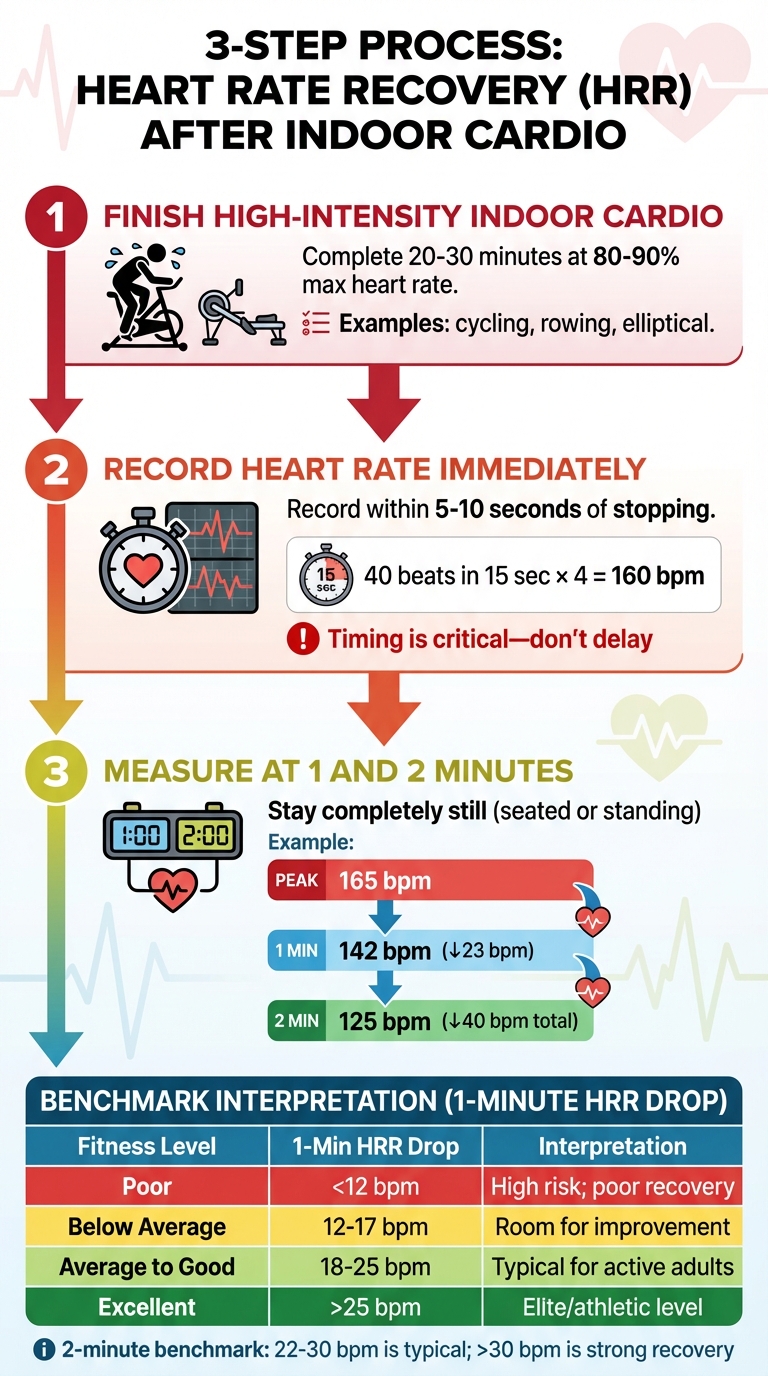
How to Measure Heart Rate Recovery in 3 Steps with Benchmarks
Tracking your heart rate recovery (HRR) is straightforward and can be done in just three steps after an indoor cardio workout. To keep your results consistent and reliable, stick to the same method every time.
Step 1: Finish a High-Intensity Indoor Cardio Workout
Start by completing a workout that pushes your heart rate to 80–90% of its maximum for 20–30 minutes. Activities like stationary cycling, rowing, or using an elliptical trainer work well for this. The goal is to reach near-peak exertion, as this sets the stage for an accurate HRR measurement.
Step 2: Record Your Heart Rate Immediately After Exercise
As soon as you stop exercising, record your heart rate within the first 5–10 seconds. You can use a chest strap monitor, a smartwatch, or even count manually. For instance, if you count 40 beats in 15 seconds, multiply that by four to get 160 bpm. Timing is key here – don’t delay.
Step 3: Measure Your Heart Rate at 1 and 2 Minutes
Stay completely still after stopping, either seated or standing. Record your heart rate exactly 1 minute and then 2 minutes after finishing your workout. These readings provide insights into different recovery phases.
- The 1-minute reading shows how quickly your heart rate drops during fast-phase recovery, which is linked to parasympathetic activity.
- The 2-minute reading gives a clearer picture of the slower recovery phase.
For example, if your heart rate drops from 165 bpm to 142 bpm after 1 minute (a 23 bpm decrease) and then to 125 bpm after 2 minutes (a total decrease of 40 bpm), these numbers can help you monitor your progress over time.
To ensure accuracy, avoid moving or delaying the measurements, as this could underestimate your HRR by 5–10 bpm. While wearable devices are generally the easiest and most consistent option for tracking, manual methods work just as well if done with care and precision.
How to Interpret Your Heart Rate Recovery Results
Once you’ve recorded your Heart Rate Recovery (HRR), understanding what those numbers mean is key to assessing your recovery and adjusting your training. Essentially, HRR reflects how efficiently your cardiovascular and nervous systems recover after exertion.
Normal HRR Benchmarks
For most adults, a drop of at least 12 bpm one minute after exercise is considered the minimum threshold for healthy recovery. Higher drops generally indicate better cardiovascular fitness. A drop of 18–20 bpm is good, while over 25 bpm is excellent. At the two-minute mark, a total drop of 22–30 bpm from your peak heart rate is typical for those with good fitness, and over 30 bpm suggests strong recovery.
For example, if your heart rate peaks at 170 bpm during a treadmill session and falls to 157 bpm after one minute, your HRR is 13 bpm – just above the minimum threshold. A greater drop, such as 18–20 bpm, would reflect better recovery, and anything above 25 bpm is exceptional.
| Fitness Level | 1-Min HRR (bpm) | Interpretation |
|---|---|---|
| Poor | <12 | High risk; poor recovery |
| Below Average | 12–17 | Room for improvement |
| Average to Good | 18–25 | Typical for active adults |
| Excellent | >25 | Elite/athletic level |
It’s worth noting that fitter individuals tend to have faster HRR. Your training history plays a bigger role here than age alone. These benchmarks provide a general guide but aren’t rigid cutoffs.
What Low HRR Means
If your HRR is below 12 bpm, it may indicate slower parasympathetic reactivation, higher cardiovascular risk, or issues like stress, poor sleep, overtraining, dehydration, or even underlying heart conditions.
Temporary factors can also lower HRR. Stressful periods, consecutive intense workouts, alcohol or heavy caffeine intake, or illness can all play a role. For instance, if your usual 1-minute HRR after rowing is 20–22 bpm but suddenly drops to 10–12 bpm during a stressful week with little sleep, it’s likely acute fatigue rather than a permanent decline in fitness. In such cases, focus on rest, hydration, and recovery before retesting.
If your HRR remains very low, worsens over time, or is accompanied by symptoms like chest pain, unusual shortness of breath, dizziness, or palpitations, consult a healthcare professional.
Monitoring HRR Progress Over Time
A single HRR measurement doesn’t tell the whole story. Tracking trends over weeks and months is a better way to gauge whether your fitness is improving or stagnating. To minimize daily fluctuations, measure HRR 1–2 times per week after consistent high-intensity cardio sessions.
Focus on rolling averages over 2–4 weeks rather than individual readings. Compare the average of three 1-minute HRR values over two weeks to your previous two-week average. A steady improvement of 3–5 bpm or more in HRR over 8–12 weeks of structured training suggests better cardiorespiratory fitness and faster recovery. On the other hand, if HRR declines alongside an elevated resting heart rate (5–10 bpm higher than your usual morning value) and increased perceived effort during workouts, it’s time to prioritize recovery.
To get a clearer picture, combine HRR trends with other simple metrics like resting heart rate (RHR) and perceived exertion. If your HRR is improving or stable, your RHR is steady or slightly decreasing, and your workouts feel manageable, you’re likely adapting well to your training program.
sbb-itb-9317277
Factors That Affect Heart Rate Recovery
Your heart rate recovery (HRR) is closely tied to how efficiently your autonomic nervous system transitions from a state of stress to recovery after exercise. Understanding the elements that influence HRR can help you differentiate between short-term fluctuations and long-term changes in your fitness levels.
Lifestyle Factors That Impact HRR
Poor sleep can significantly impair HRR. When you don’t get enough rest, your resting heart rate tends to rise, making recovery slower. To improve HRR, aim for 7–9 hours of sleep each night, stick to consistent bedtimes and wake-up times, limit screen exposure in the hour or two before bed, and create a sleep-friendly environment by keeping your bedroom cool and dark.
Hydration and nutrition are equally important. Dehydration puts extra strain on your cardiovascular system, slowing the return of your heart rate to its baseline. Staying properly hydrated and eating balanced meals can help maintain accurate HRR readings. Additionally, cutting back on alcohol and avoiding excessive caffeine – especially later in the day – can improve sleep quality and support a healthier nervous system.
Chronic stress is another factor that can slow recovery. Using stress-management techniques like slow diaphragmatic breathing for 5–10 minutes after workouts, taking short daily walks, or practicing mindfulness can encourage your nervous system to shift into recovery mode. Tracking stress levels alongside HRR readings can also help pinpoint areas where recovery might be falling short.
Beyond these lifestyle changes, structured exercise routines can further improve HRR.
Improving HRR Through Indoor Cardio
Regular indoor cardio workouts can enhance HRR and improve overall cardiovascular health. Engaging in activities like treadmill running, cycling, or rowing for 3–5 days per week at the right intensity can lead to noticeable improvements in 1- and 2-minute HRR within 6–12 weeks.
To make steady progress, gradually increase the intensity and duration of your cardio sessions. Interval training – where you alternate between 1–3 minutes of higher intensity and equal or slightly longer recovery periods – is particularly effective for training both heart rate acceleration and recovery. Tools like Indoor Cardio Pro offer structured routines and safety tips to help you design these workouts, whether you’re exercising at home or in a gym.
While consistent training is key, recovery days are just as important for optimizing HRR.
How Recovery Days Improve HRR
Recovery days give your body the chance to repair and adapt, which helps lower your resting heart rate and improves HRR. Instead of complete rest, consider active recovery activities like 20–30 minutes of light indoor cycling, easy treadmill walking, or gentle calisthenics. These exercises promote blood flow without adding unnecessary strain.
A common practice is to alternate 1–2 days of high-intensity cardio with a day of lighter activity or rest. Monitoring HRR on recovery days can provide insights into how well your body is adapting to your training routine. If your HRR consistently dips below normal levels, it may be a sign that your body needs more recovery. In such cases, scaling back workout intensity or volume, improving sleep, and incorporating more low-intensity movement can help your HRR return to its usual pattern.
Because HRR reflects how efficiently your body transitions out of exercise-induced stress, a sudden drop – especially when paired with a higher resting heart rate, fatigue, or poor sleep – can signal incomplete recovery. Adjusting your training plan to include more rest or active recovery can help restore balance.
Tools for Tracking HRR
Once you’re clear on how to measure and interpret your heart rate recovery (HRR), the next step is selecting the right tool for the job. Tracking HRR effectively means capturing your heart rate right after exercise and then again at 1- and 2-minute intervals. You can do this using wearable heart rate monitors, fitness tracking apps, or even manual pulse counting.
Wearable Heart Rate Monitors
Chest-strap monitors are known for their accuracy when it comes to tracking HRR. They rely on electrical signals to detect heartbeats, which makes them great for capturing early recovery data with precision. On the other hand, smartwatches and fitness bands use optical sensors (PPG) to measure blood flow. While these are more convenient for everyday use, they might not be as precise during high-intensity activities. For instance, the Oura Ring Gen3 offers continuous heart rate tracking during workouts and allows for easy HRR checks at 1-, 2-, or 3-minute intervals using its Workout Heart Rate feature. When choosing a wearable, look for one with a high sampling rate, continuous recording for at least 2–3 minutes, and a secure fit to reduce errors during activities like running, rowing, or cycling. Also, consider how well the device integrates with apps for a smoother tracking experience.
Fitness Tracking Apps
Fitness tracking apps are another convenient option. They can sync with wearables to import heart rate and workout data, calculate HRR, and even show trends over time. These apps typically track key metrics like your peak heart rate and recovery values at 1- and 2-minute intervals. However, keep in mind that an app’s accuracy depends on the device it’s paired with, and different apps may use varying recovery timeframes (like 1-minute versus 2- or 3-minute intervals). When picking an app, choose one that clearly displays both peak and recovery heart rates. To get consistent results, try to record similar workouts at comparable intensities.
Manual Tracking Methods
If wearables or apps aren’t an option, you can still measure HRR manually. Right after finishing your workout, count your pulse for 15 seconds, multiply that number by 4 to get beats per minute (bpm), wait 1 minute, then repeat the process. Subtract the second value from your peak heart rate to calculate your HRR. While this method is free and accessible, it’s more prone to human error. To improve accuracy, use a timer with a clear second display, have the same person take your pulse each time, and perform the test under consistent conditions, like at the same time of day. This traditional approach may lack the precision of technology but remains a solid backup when devices aren’t available.
Conclusion
Heart rate recovery (HRR) is a powerful way to measure your cardiovascular fitness. By tracking how quickly your heart rate drops – typically within 1 or 2 minutes after a high-intensity indoor cardio session – you can get a clear picture of how well your body recovers. A faster drop in heart rate is a strong indicator of good fitness levels.
Regularly monitoring your HRR can show how your fitness evolves over time. As you stay consistent with your indoor cardio workouts and allow for proper recovery days, you may notice improvements in both your HRR and your peak oxygen uptake (VO2peak). These gains not only reflect better fitness but also contribute to reduced risks of chronic diseases, quicker stress recovery, and a stronger cardiovascular system.
Ready to take action? Start by incorporating high-intensity cardio sessions into your routine and giving your body the recovery it needs. Track your HRR after each session – ideally aiming for a 15–20+ bpm drop at the 1-minute mark – and reassess every 4–6 weeks. Celebrate each improvement as a step toward better heart health. For more tips on refining your indoor cardio workouts and improving your HRR, visit Indoor Cardio Pro.
FAQs
What are the best ways to improve heart rate recovery?
Improving your heart rate recovery requires a mix of regular cardio workouts, gradually ramping up exercise intensity, staying hydrated, and getting plenty of rest. These steps work together to strengthen your cardiovascular system and enhance how your autonomic nervous system responds during recovery.
To see better progress, try incorporating interval training into your routine. This type of exercise alternates between high and low intensity, challenging your heart in a balanced way. Don’t overlook the importance of recovery – make sure you’re prioritizing quality sleep and managing stress effectively. With time and consistency, these habits can lead to noticeable gains in how quickly your heart rate returns to normal after exercise.
What can affect my heart rate recovery in a negative way?
Several things can affect how quickly your heart rate returns to normal after exercise. These include fatigue, overtraining, dehydration, stress, poor sleep, illness, and even certain medications. Each of these factors can disrupt your body’s ability to recover effectively.
If you want to improve your heart rate recovery, try focusing on a few key areas: stay well-hydrated, manage your stress levels, prioritize quality sleep, and pay attention to your body to avoid overtraining. If your recovery seems unusually slow or you’re concerned, it’s a good idea to check in with a healthcare professional to rule out any potential health concerns.
Why should I monitor my heart rate recovery over time?
Monitoring how your heart rate recovers after exercise is an effective way to gauge your cardiovascular fitness and overall well-being. It measures how quickly your heart rate returns to its resting level, offering insights into how efficiently your body recovers.
A quicker recovery typically points to better fitness and a healthier cardiovascular system. On the other hand, a slower recovery might signal the need for changes in your training routine or lifestyle habits. By keeping an eye on this metric over time, you can identify patterns, set meaningful goals, and track your progress on your fitness journey.